Most carpentry work in Singapore happens in HDB flats — and HDB carpentry has its own set of practical considerations that differ from condo or landed renovations: standard layouts, permit rules, BTO vs resale timing, and space-efficient design for smaller footprints. Here's a practical walkthrough.
BTO vs resale: what's different
BTO flats
New BTO units are essentially blank canvases — bare walls, standard dimensions, no existing built-ins to remove. This makes design and measurement straightforward, but timing matters: carpentry typically starts only after keys are collected and any hacking, electrical, or plumbing work is confirmed and scheduled.
Resale flats
Resale flats often come with existing wardrobes, cabinets, or partitions that need to be removed first, and walls that may have settled unevenly over the years. Measurement needs a bit more care here, and built-in pieces are typically custom-fitted to the actual (not assumed) wall dimensions rather than standard sizes.
| BTO | Resale | |
|---|---|---|
| Starting condition | Bare walls | Often has existing built-ins |
| Wall accuracy | Standard, predictable | Can be uneven, needs careful measurement |
| Typical timeline | After key collection + any hacking works | After removal of existing fixtures |
| Design flexibility | High — clean slate | Constrained by existing layout/wiring |
HDB renovation permit basics
Standard built-in carpentry — wardrobes, kitchen cabinets, TV consoles — generally doesn't require an HDB renovation permit on its own, since it doesn't alter the flat's structure. However, if your project involves any of the following, a permit is typically required and should be confirmed before work starts:
- Hacking of walls (including non-structural partition walls in some cases)
- Plumbing relocation (sink, pipe rerouting)
- Electrical rewiring or new points beyond standard switches
Space-efficient design for HDB layouts
HDB flats — especially 3-room and 4-room units — benefit from carpentry designed around the constraints of the space rather than generic full-height runs everywhere:
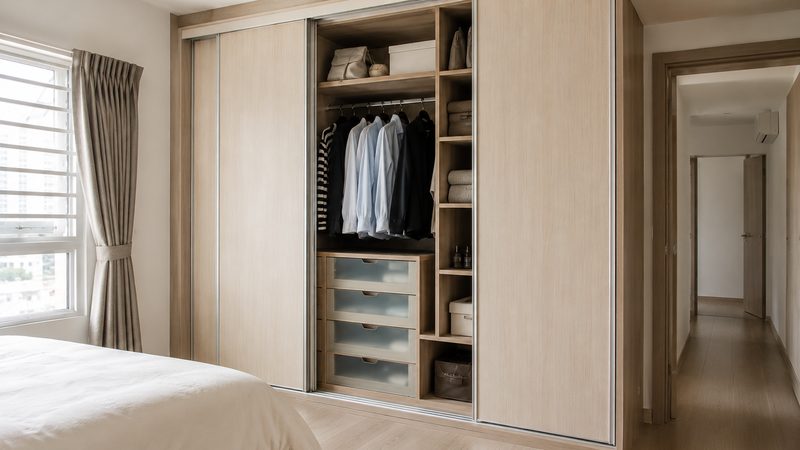
- Bedroom wardrobes: sliding doors save floor clearance in smaller rooms compared to swing doors, which need open-door clearance
- Kitchen cabinets: galley or L-shape layouts are common in HDB kitchens; vertical storage (tall units) maximises a small footprint better than wide, shallow runs
- Living room: a floating TV console frees up floor space for cleaning and visually opens up a smaller living room compared to a floor-standing unit
Typical timeline
- Site visit and measurement — 1 day, after any hacking/plumbing/electrical works are done
- Design confirmation — usually 3–7 days of back-and-forth on layout, material, and finishes
- Fabrication — 3–4 weeks in the workshop
- Installation — 1–2 days on-site for a standard wardrobe or kitchen set
Most homeowners budget 5–6 weeks from final design sign-off to a completed install — worth factoring in if you're coordinating with other renovation trades.
Planning carpentry for your HDB flat?
WhatsApp us your flat type and rough timeline — we'll advise on what's possible and arrange a site visit.
WhatsApp UsCan work be done while living in the flat?
Yes, for most standard built-in carpentry. It generates relatively little dust compared to hacking or tiling work, though there's noise during installation (drilling, fitting). Clearing the work area beforehand — especially for wardrobe or cabinet replacements — speeds things up considerably.