One of the most common questions we get before a site visit: "How much does a built-in wardrobe cost in Singapore?" The honest answer is that it depends — but not in a vague, unhelpful way. There are a handful of specific factors that drive the price, and once you understand them, you can budget accurately and spot quotes that are either overpriced or cutting corners.
Here's what actually moves the number.
The short answer: typical price ranges
| Wardrobe width | Rate | Estimated cost (cabinets) |
|---|---|---|
| 5 ft swing wardrobe (max height 2,600 mm) | $264/ft | $1,320 |
| 6 ft swing wardrobe (max height 2,600 mm) | $264/ft | $1,584 |
| 8 ft swing wardrobe (max height 2,600 mm) | $264/ft | $2,112 |
| 10 ft swing wardrobe (max height 2,600 mm) | $264/ft | $2,640 |
| Sliding door / walk-in system | Contact for quote | |
These are direct-contractor rates. If you're going through a renovation company that subcontracts the carpentry, add 20–40% on top.
What actually drives the price
1. Size and linear footage
Built-in wardrobes are priced at $264 per foot, with a maximum height of 2,600 mm. Width is the primary variable — a 5 ft unit works out to $1,320; a 10 ft unit comes to $2,640. Height matters too: a floor-to-ceiling build at maximum height uses more board than a lower unit, which is factored into the rate.
2. Board thickness and brand
The structural carcase (the frame you don't see) should be 18mm particleboard minimum. Some contractors quote cheap on 15mm or even 12mm boards — these bow under load within 2–3 years in Singapore's humidity. Always ask what thickness is being used for the carcase. For back panels, 9mm is standard and fine.
3. Laminate finish
Basic textured laminate (Formica, Lamitak, or equivalent) is the default and works well for most HDB and condo bedrooms. Premium matte, wood-grain, or high-gloss laminates add $150–$400 to a standard 2-door unit. Lacquer finishes cost more and require more careful maintenance. For most bedrooms, a good standard laminate is the right call.
4. Door type
Swing doors are simpler to build and maintain — hinges are easy to adjust if alignment shifts over time, which happens with Singapore humidity. Sliding doors cost more upfront (the track hardware alone adds $300–$600) and require wider clearance space, but are better for tight rooms where you can't swing a door open. Soft-close hinges on swing doors are worth the small upcharge — they prevent door slam and hold alignment longer.
5. Internal fittings
This is where quotes diverge most. A basic wardrobe is just shelves and a hanging rail. Every addition costs money:
- Pull-out drawers: $80–$180 per drawer (soft-close adds ~$30)
- Pull-out trouser/tie rack: $60–$120
- Internal LED lighting: $80–$200
- Mirror panel (internal): $100–$250 depending on size
- Shoe rack section: $150–$300
When comparing quotes, check what's included in the internal layout — a $1,200 quote with no drawers versus a $1,600 quote with four drawers and proper rail fittings may actually be the same value once you add what you need.
Direct carpenter vs renovation company
Most renovation companies don't have their own carpenters. They manage the project and subcontract the woodwork — sometimes to good workshops, sometimes not. This adds cost (the markup) and a communication layer (your feedback reaches the carpenter through a middleman).
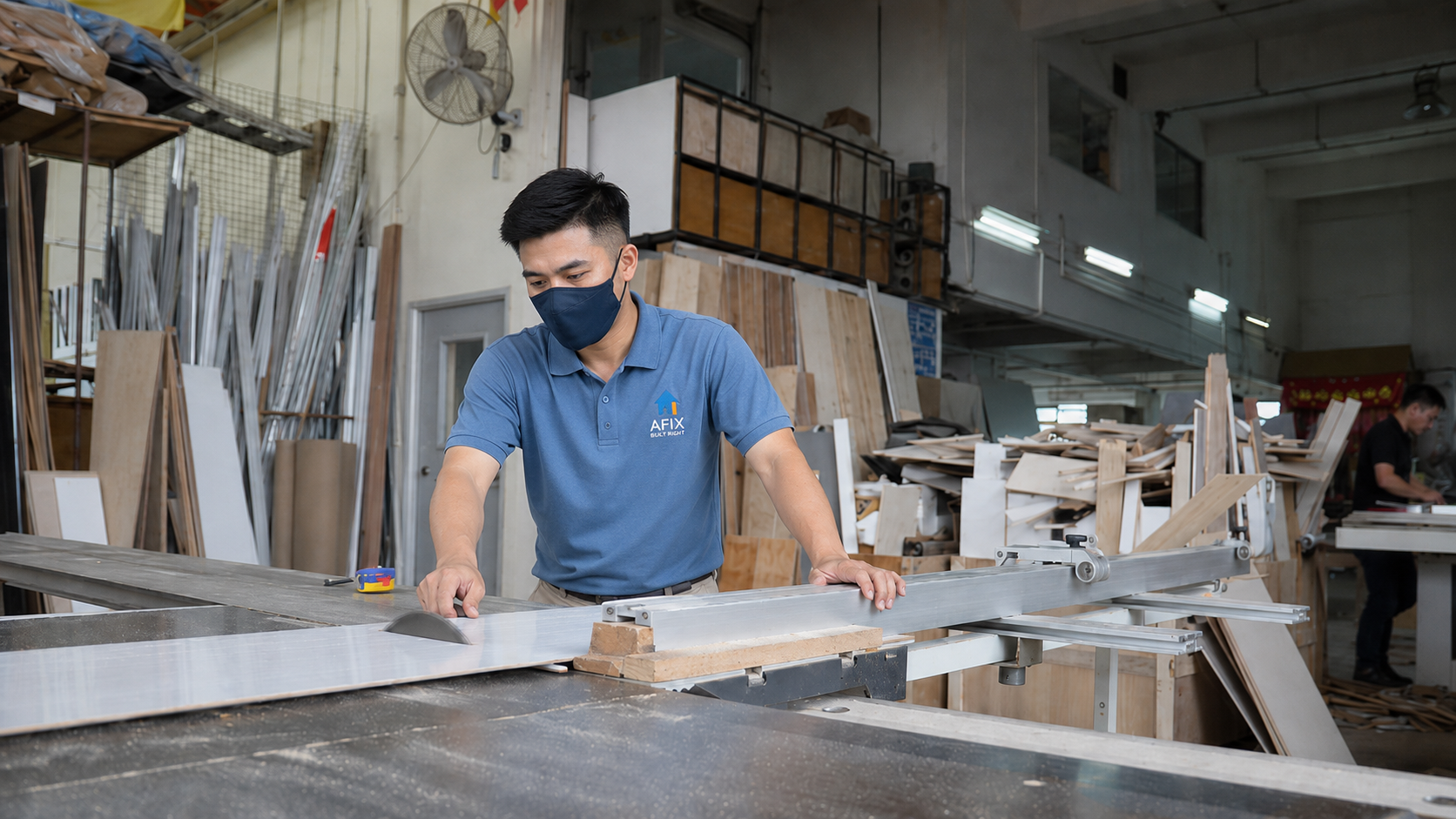
Going to a direct carpenter like AFIX means the same team that builds your wardrobe installs it. If measurements are off or a door needs adjusting, there's no back-and-forth between companies. You can also visit our workshop, see the wood samples and laminates in person, and understand exactly what you're getting before fabrication starts.
For a single wardrobe, the savings from going direct typically range from $200–$600. For a full-room fit-out, it's more.
HDB vs condo: does it change the price?
Not directly — the property type doesn't change carpentry costs. What changes is the typical ceiling height and layout constraints. HDB standard ceiling is 2.6m; newer HDB BTO can be up to 2.8m. Condo units vary more widely. Floor-to-ceiling units cost more at higher ceilings simply because there's more board.
One HDB-specific note: if your wardrobe is going into a bedroom against the wall opposite the main door, check whether the door swing gives you enough clearance to open the wardrobe fully. It's a common oversight that's easy to plan around at the design stage and expensive to fix after installation.
What to check before you sign a quote
- Board thickness — 18mm carcase, 9mm back panel
- Laminate brand — ask to see the swatch book in person
- Internal layout drawing — should show exact shelf positions, rail heights, drawer count
- Hinge brand — AFIX uses Jasmine brand hinges and drawer runners as standard. When comparing other quotes, always ask what brand is being used
- Who fabricates — in-house or subcontracted?
- Lead time — 3–4 weeks is standard; anything under 2 weeks for a custom piece is a red flag
- What's excluded — electrical for lighting, wall patching, painting are sometimes separate
Get a quote for your wardrobe
WhatsApp us with your bedroom dimensions or floor plan. We'll arrange a site visit and come back with an itemised quote within 2 working days.
WhatsApp for a QuoteIs a built-in wardrobe worth it vs a freestanding one?
For most Singapore bedrooms, yes — especially HDB rooms where the ceiling height and wall dimensions are fixed. A built-in wardrobe uses every millimetre of ceiling-to-floor space, doesn't shift or topple (a real consideration with kids or earthquakes), and adds perceived square footage because it's flush with the wall.
Freestanding wardrobes from IKEA or similar cost less upfront but waste headspace, can't be configured for your exact room, and rarely last as long under heavy use. If you're staying in a place for more than 2–3 years, built-in almost always wins on total cost of ownership.